

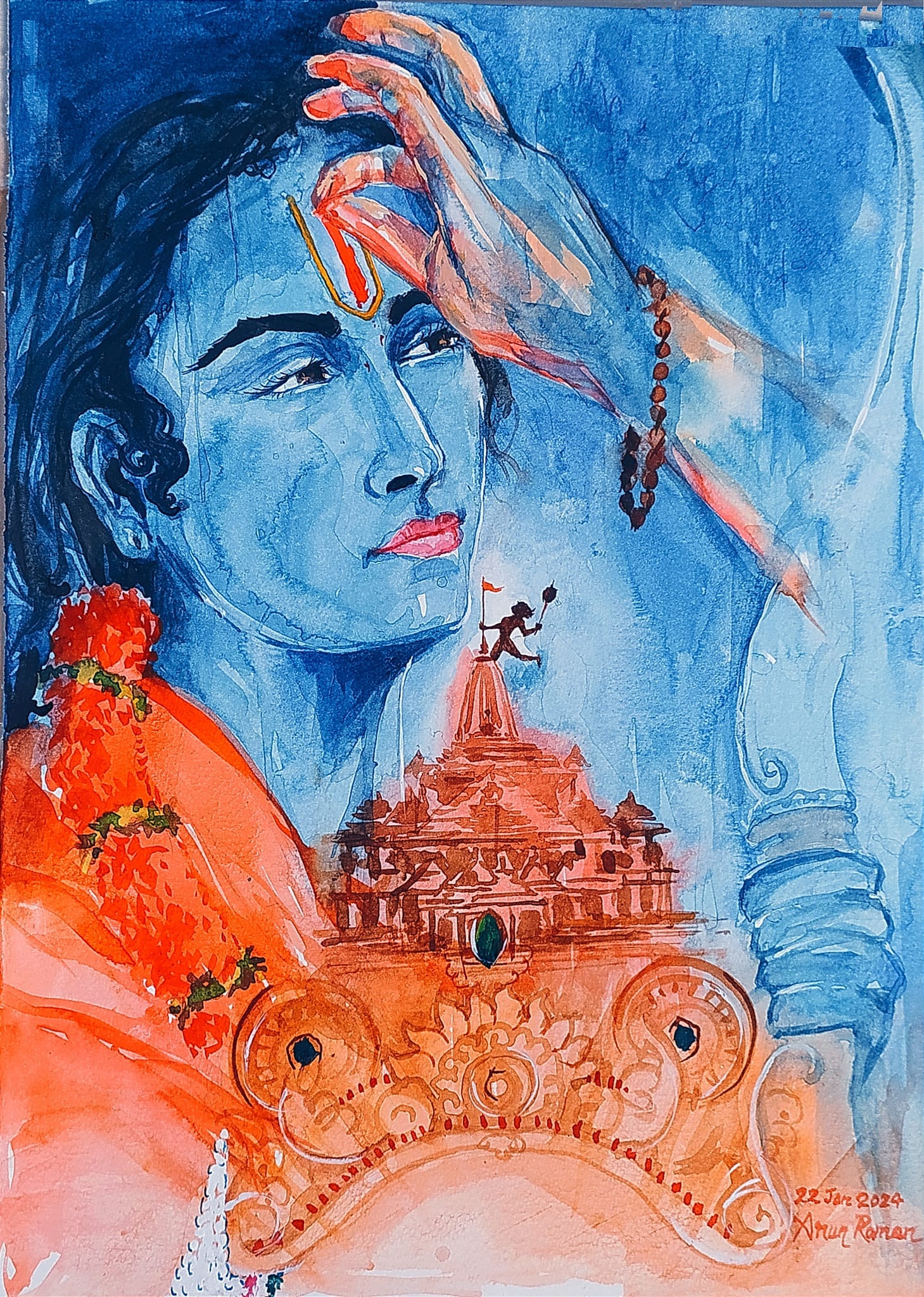
The Indian nation passed a critical moment in its history with the prāṇa pratiṣta of the Bhavya Ram Mandir in Ayodhya yesterday. Depending upon which side of the ideological divide you may find yourself in, this would have evoked or provoked you. Irrespective of the politics behind your personal response, this is a moment that holds potential for nurturing a new possibility for all communities.
“Everything that irritates us about others can lead us to an understanding of ourselves.” - Carl Jung, Psychologist, Philosopher & Researcher of the human mind
As the day progressed, my timeline on social media and WhatsApp got filled with competing narratives of victory, victimhood, joyous celebration, and contemplative questioning of the meaning of it all. Honestly, it did feel overwhelming to me.
As I restrained my temptation to get into the arguments and take sides, there was a moment of self check-in which brought me back to a central question":
Whither Ayōdhya? What is the future or possibility of a world devoid of conflict and war?
Who am I being in today’s context?
What is the impact and the price I am paying for my choices - at the level of intent, word, and action?
Personally, I felt very joyous and celebratory about the entire event and what it means to the civilisation that I belong to. As I engaged with the barrage of texts questioning the celebration, for every point I realised I had a ready counter in my mind. For every image of the Preamble of the Constitution of India shared, I had the image of Part 3 of the Constitution of Indian which carried the image of Rāma, Sīta, and Lakshmaṇa, on top of Fundamental Rights. Then there was this part of me which could see the intensity of the provocation, the rage that comes with feeling unseen and unheard by the other. And in giving in to that rage, I could feel the stuckness I experienced in extending a feeling of maitri (friendship) to those who hold a different view and perspective from me. That was the moment I knew that the more I give in to this pattern of ‘othering’, the more the space of Rāma and Ayōdhya will be out there in the world and not within me.
Holding this in my awareness for a while settled the heaviness and agitation within me. The beauty of the new mandir started seeping in and the chants started feeling soothing. In that moment of silent awareness, I feel I touched a space of beauty and silence within. A glimpse of the Ayōdhya when the inner conflict ceased, and a glance of the grace of Rāma space within. From this space, my intent, word or action can carry nothing but maitri. But can I stay in this Ayōdhya in me for long? Can I anchor in the Rāma space within when the world breaks havoc around me and my own compulsive patterns show up? That perhaps is the significance and essence of abhyāsa (practice). The more I practice moving towards my own Svabhāva, perhaps I can keep rediscovering traces of the treasure trove of Rāma and Ayōdhya within me.
Would you like to join me as a co-traveller on this journey to discover your own Rāma space and experience the Ayōdhya within?
Jai śrī Rām!