

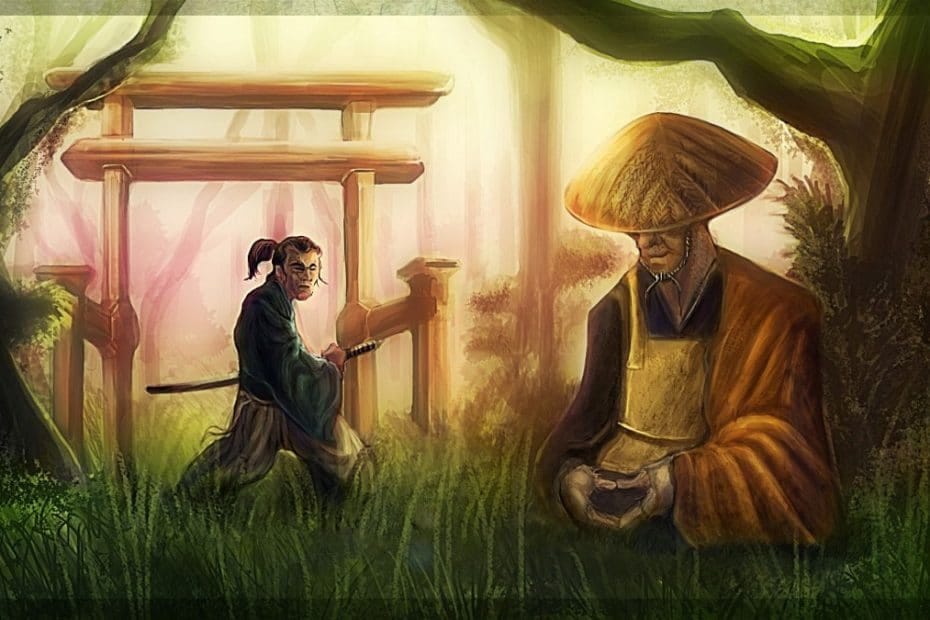
Once upon a time, a fierce Samurai went to a Zen master to ask about heaven and hell. “Tell me the nature of heaven and hell!”, demanded the Samurai. The Zen master was not impressed by the aggression displayed by the Samurai. “You’re nothing but a fool! You’re too stupid to understand such things. Go away!”, said the Zen master in disdain. Enraged by this insult, the Samurai drew out his katāna (a fierce long sword), and was about to strike the Zen master. The master calmly said, “This is hell.” Having realised how his rage and violence created his own suffering, the Samurai lowered his sword and bowed in gratitude. “And this is heaven.”, added the Zen master. This Zen story beautifully captures the innate potential in human beings to be both violent as well as to grow through awareness and realise their highest potential.
We live in a world that is increasingly torn by war and a media that thrives on the human tendency to feed on violence. So how does this collective preoccupation with violence impact individual well-being? Perhaps, the ability to discover non-violence (ahimsa) is key to our individual and collective well-being.
Is Violence Inherent To Us?
“The nature of himsa (violence) is very much a part of our nature. Hence, in Patanjali’s Yoga Sūtras, the practice is articulated as that of ahimsa, acknowledging that violence is part of our very being.”, says Saraswathi Vasudevan, student of Yoga Ācharya Sri TKV Desikachar and co-founder of YogaVahini Foundation, Chennai.
All living beings have a natural urge for self-preservation. When we perceive a threat, this deep seated urge springs forth. Trauma healing modalities such as Somatic Experiencing, speak of fight, flight, or freeze energies that arise and get stuck in the nervous system during such moments. Yoga speaks of the ways in which flow of one’s prāṇa (life force) can get blocked due to knotting up of the nādīs (energy pathways) leading to illnesses.
Albert Einstein once stated that the most important decision we will every make is whether we believe in a friendly or a hostile universe. If our perception of the world is it being a hostile place, then our response to life and beings around us will carry seeds of violence that will ultimate impact our own health and well-being. So, how does one nurture a way of being that is anchored in a sense of friendliness (maitri) and compassion (karuṇa) towards ourselves and the world?
Understanding Violence Through Yogic Lens
“We can truly understand and practice non-violence (ahimsa) only by understanding our own intrinsic potential to inflict violence (himsa) on ourselves and others.”, says Saraswati, as she reflects on the practice of ahimsa.
“vitarkā himsā-ādaya: kṛta-kārita-anumoditā lobha-krodha-moha-pūrvakā mrdu-
madhya-adhimātrā dukha-agnyāna-ananta-phalā: iti pratipakṣa bhāvanam.” - Y.S. 2.34
Patanjali’s Yoga Sūtrās mention three ways in which one can create violence. One can inflict violence directly (krta) by oneself, indirectly (kārita) by instigating others to act, or by being an approving bystander watching violence committed by another (anumodita). Also, it specifies six human traits that create discolorations of the mind and instigate violence, viz., lust (kāma), anger (krodha), or delusion (moha), greed (lobha), intoxication (mada), and envy (mātsarya). The intensity of compulsion one feels to act out in violence may be mild (mrdu), medium (madhyama), or intensely strong (adhimātra).
In my coaching and therapy sessions with clients, I have often observed how the onset of various health issues begins with violation of some of the basic elements of healthy living. This include repression of emotions, irregular diet and sleep, lack or excessive exercise routines, etc. “I remember the first time I started working out and focusing on my body, I also started prioritizing my food and other schedules in life. The more I understood myself, more was my capacity to understand others and systems.”, says Dhvani Thakkar, a peacebuilder, educator, and designer based out of Costa Rica.
Discovering Ahimsa
Yamas in Aṣtāṇga Yoga are a set of practices around inter-personal conduct of which ahimsa is the foundational practice.
ahimsā-pratiṣṭāyām-tat-sannidhau-vaira-tyāga: - Y.S. 2.35
Yoga Sūtras state that in the presence of a person who has renounced (tyāgam) violence (vairam) from within themselves and is anchored ((pratiṣta) in a deep sense of equanimity (śāntam), anyone holding on to violence can experience the dropping away of violence from their inner space and feel connected to the śāntam within themselves. Practice of ahimsa becomes possible when you are able to discover a location within you from where you are not dislocated by the experiences of the world.
For this, you need to cleanse the residues accumulated from life experiences from your system through a right set of practices. “The whole purpose of Aṣtāṇga Yoga is to purify oneself of all the impurities that one has gathered in the past, continue to gather in the present, and will continue to gather in the future.”, says Saraswati. “Through the practice of āsana, prāṇāyāma, and pratyāhāra I can see what patterns of himsa I am holding on to in my life, what are its roots, intensity, and discover who would I be if I did not have these in my life.”, adds Saraswati.
“Ahimsa is not about being too cautious about getting hurt or hurting others too, as I believe this comes from an inner location of victimization and vigilance. Ahimsa, on the other hand, comes from a space of deep clarity and compassion to oneself and the other.”, says Anita, a yoga therapist and healing facilitator, and founder of Vishoka in Coimbatore. “Ahimsa to me is being sensitive and understanding of what can harm me or others and therefore to avoid harming others or being harmed.”, adds Anita.
Practicing Ahimsa
Yoga Sūtras state that the way to end the cycle of violence arising out of one’s innate traits is to imagine in one’s mind as to how these actions will create the experience of grief and ignorance as an unending consequence. This process is referred to as pratipakṣa bhāvana.
Dhvani designed a game called Dialog which enables a self-reflective context in which one can practice heartful conversations through a series of prompts. “The practice of sharing in the circle during the game enables discovery of who we really are as a person and be vulnerable. This gives us a real chance to discover what peace and compassion may look like for ourselves.”, says .
“At the end of each day, go through the day in your mind while observing your breath and body. As you revisit an experience, if you notice any disturbance in your breath or body, know that you are holding some residue from that experience. The pratyāhāra practice then will be to consciously let go of that energy from your system.”, shares Saraswati.
Our sense of well-being is defined by our mind. Our sense of well-being begins to improve only when we begin to see our reality differently. “When I develop the capacity to see that I am not separate from this world, and that what I see as a problem with the world is also inside me, then I can look at life experiences in a lighter manner.”, shares Saraswati.
“Only if we slow down we can practice Ahimsa.”, says Rajni Bakshi, author and founder of the YouTube channel ‘Ahimsa Conversations’. “This would mean different things to different people. Creating fallow spaces and unstructured time in everyday life will create the necessary conditions for this.”, adds Rajni.
Perhaps singer John Lennon captured the spirit of ahimsa in his campaign towards world peace as he sang in Imagine:
“You may say I’m a dreamer,
But I’m not the only one.
I hope someday you’ll join us,
And the world will live as one.”
P.S.1: This article was originally published on Mint Lounge on 29th October 2024. You may read it here.