

Have you heard of certain phrases that capture your imagination in inexplicable ways? Then sometimes they stick around long enough for you to live them.
For me, one such phrase is “here and now”. It opens up a whole universe of truth, belonging, and presence that is infused with freedom, choice, and transformative potential.
I may have first heard this phrase around 20 years ago when I read Eckhart Tolle’s landmark book “Power of Now”. Eckhart speaks of the “here and now” as the only reality and the key to inner peace, accessible by fully accepting the present moment without mental judgment.
Though the language felt new in English, the process felt very familiar in my body and mind. Throughout my teenage and college years, I’ve been extensively involved in learning, practising, and creating experiential learning spaces rooted in ideas from the Bhagavad Gita, Vedanta, and Upanishads through my association with the youth wing of Chinmaya Mission, namely Chinmaya Yuva Kendra (CHYK).
Much later, as I got formally introduced to process work through organisations like Ritambhara and Sumedhas, I could connect the dots between the philosophy and practice of process work from my own lived experience of it. Below, I’ve shared my current understanding of some of the core tenets of Process Work and the parallels I see in certain concepts from the Indian Knowledge Systems.
I invite you to read through this as reflections from a practitioner and learner-facilitator of Process Work. I do not claim any originality of thought in what I have shared below. What is real and original is my lived experience of the ‘Aha!’ moments during this journey.
Process Work
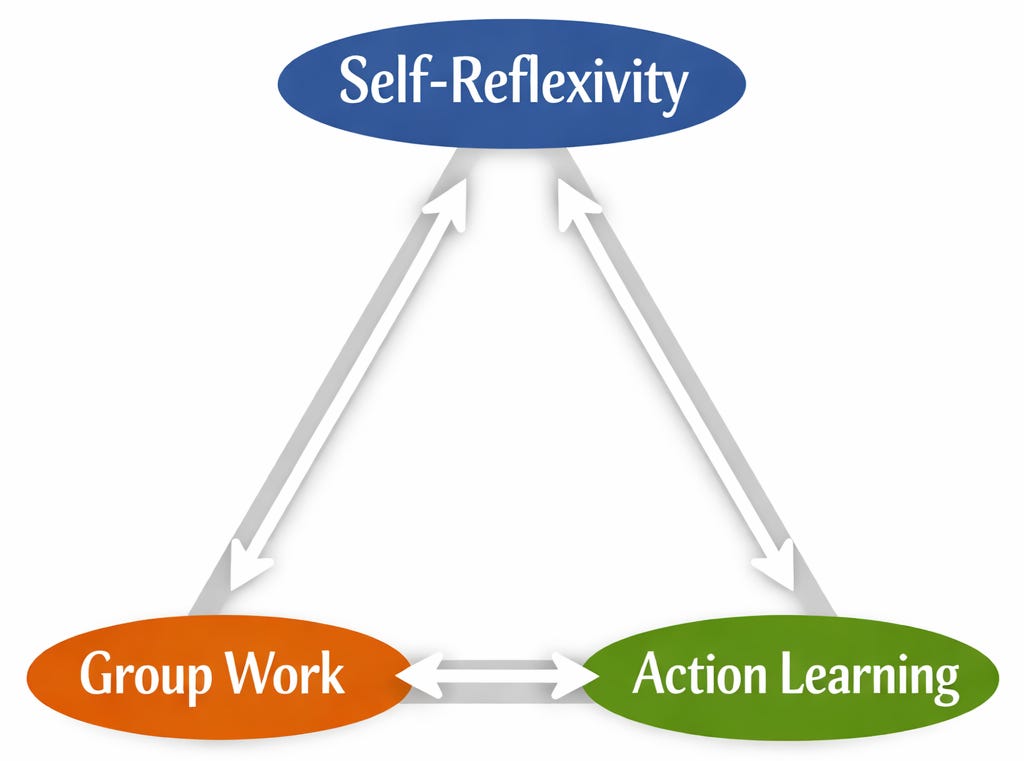
Sushanta Banerjee, one of the co-founders of Sumedhas, writes about Process Work as a tripodal body of knowledge in his paper ‘What is Process Work’? The three legs of this tripod are:
Self-reflexivity: The capacity to raise questions about the nature and unfolding of one’s own existence, its meaning, and purpose, amongst other things. This involves deep listening to the self, other, and the system simultaneously.
Group Work: The group is taken as the elemental unit of study in Process Work. The dissolution of the subject-object divide through the simultaneous self-reflective study of the group and its members is a core aspect of Process Work.
Action Learning: A commitment to action based on the discoveries during the self and group work is essential in closing the Gestalt and creating a new whole in the Process Work method.
In this, I find a clear parallel with the Bhārathīya (Indic) approach to learning and integration, which has been my path of knowledge and practice for over three decades.
Svādhyāya & Self-Reflexivity
स्वाध्याय प्रमादितव्यम्
svādhyāya pramāditavyam
- Taittirīya Upanishad
The idea and practice of svādhyāya is a core part of the Vedantic tradition. The etymology of svādhyāya is sv (स्व) and adhyāya (अध्याय). The above phrase from Taittirīya Upanishad translates to a reminder, viz., “to never neglect self-study”. The roots of adhyāy is “dhyai” (ध्यै) which means to meditate or contemplate upon.
This self-reflective contemplation during svādhyāya on the nature of the true self within us beyond the role identities that we normally associate in transactional living the capacity of self-reflexivity that enables one to ask fundamental questions about the nature and unfolding of one’s own existence.
During my own journey through various spaces of learning and practice, I’ve always felt drawn more to spaces that help me discover more of who I am and enable that movement towards seeing my own inner reality and processes that co-create it.
Principle of Simultaneity
ऋतं च स्वाध्यायप्रवचने च । सत्यं च स्वाध्यायप्रवचने च । तपश्च स्वाध्यायप्रवचने च । दमश्च स्वाध्यायप्रवचने च । शमश्च स्वाध्यायप्रवचने च । अग्नयश्च स्वाध्यायप्रवचने च । अग्निहोत्रं च स्वाध्यायप्रवचने च । अतिथयश्च स्वाध्यायप्रवचने च । मानुषं च स्वाध्यायप्रवचने च । प्रजा च स्वाध्यायप्रवचने च । प्रजनश्च स्वाध्यायप्रवचने च । प्रजातिश्च स्वाध्यायप्रवचने च ॥ १ ॥
- Taittirīya Upanishad (1.9.1)
Taittirīya Upanishad also emphasises the central importance of svādhyāya in one’s pursuit of reality (ṛta), truth (satya), self-restraint (damah), perseverence (tapas), tranquility and inner peace (samas), and relationship with others, family, and guests (praja, prajana, mānushi, atithi), and all rituals (agnaya, agnihōtram).
Thus, the inquiry into the nature, meaning, and purpose of the unfolding of reality as one experiences it, as well as the deep listening to self, other, and the system simultaneously, is enabled through the svādhyāya process.
“You are this, that, and more.”
- Dr Pulin K. Garg (Former Professor of Organisational Behaviour at IIM-A)
In the Sumedhian tradition of Process Work that I have experienced, the principle of simultaneous co-holding of polar locations in the present moment is integral to the process of self-reflexivity.
As a participant, this has allowed me to simultaneously witness and own up to who am I being and where I am right now, while also getting a sense of the emergent possibility of who I could be and where I feel called to move to.
The idea that there is a more-ness to who I am than what I have consciously or unconsciously identified with right now opens up a world of possibilities for self-discovery and transformation. I’ve experienced this possibility as both immensely scary and hopeful at the same time, for points to both the gifts and shadows that I hold within me that need to be seen and owned up.
“Homo sum, humani nihil a me alienum puto.”
“I am human, nothing that is human is alien to me."
- Terence
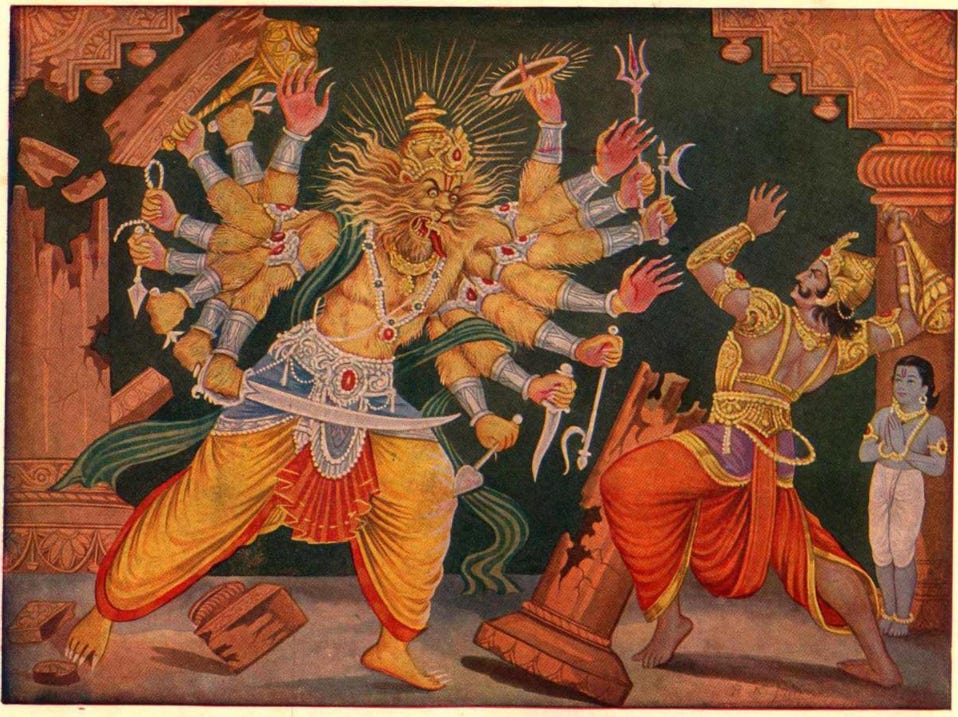
In short, I have come to realise that I hold the potential to be both Prahlāda and Hiraṇyakashipu in the way I live my life and engage with the world around me. Process Work labs that I have been part of over the past 7 years have helped me see and experience both the daivik (energising and heroic) and āsurik (compulsive and dysfunctional) parts of myself in different roles and identities in various contexts of my life.
Process Work as a method allows for me to deep dive into my role and identity patterns, discover these different parts, and engage with them from a space of meditative awareness (śāntam), compassion (karuṇa), and wonderment (adbhutam). This sets up the energetic field for the alchemy of transformation of the dysfunctional patterns into gifts that can be unfolded for living a fulfilling life.
Sangha & Group Work
Being part of Process Work spaces has offered me a context where the gift of being each other’s mirror helped group members to see past their personal blind spots around their identity and role-taking patterns. In a Process Work space, simultaneous self-reflective study of and by the group and its members potentially leads to the dissolution of the subject-object divide.
The idea of a dynamic phenomenon that is characterised by a continual movement (gati), a deep meaningful order (niyati), and a co-created coherent emergence that is essentially whole (saṅghaṭana), is captured in the Sāṅkhya darśana, one of the six major schools of Indian philosophy.
Gati (Movement)
In Sāṅkhya, gati refers to both the physical motion as well as the directionality of prakṛti as it unfolds.
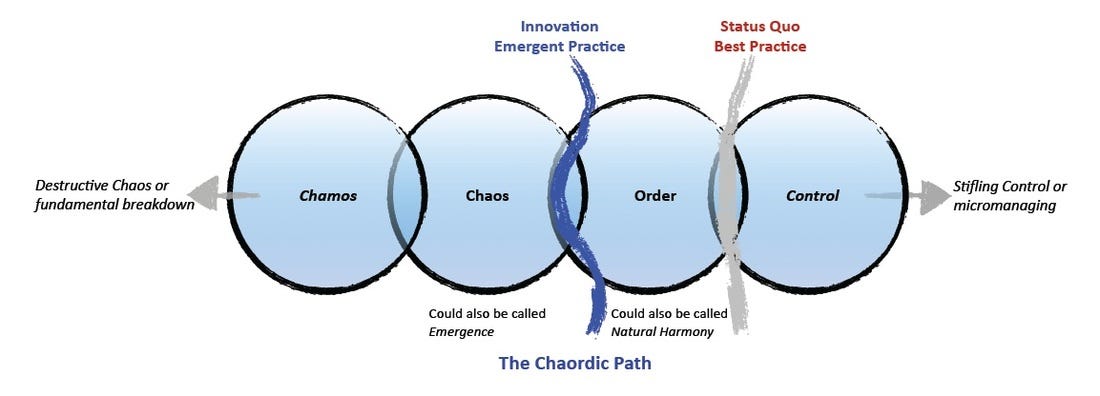
During my Flow Game training, I was introduced to the idea of a chaordic path, i.e, the path that walks between chaos and order. A term first coined by Dee Hock, former CEO of Visa, to refer to the experiment he tried out while attempting to design a system that is coherent without being controlled, ordered without being rigid, and alive without collapsing into chaos.
Dee Hock’s notion of the chaordic path reaffirms the Sāṅkhyan idea of gati. The movement in a system is not from certainty to certainty, but from tension to pattern. Order is not imposed on chaos; it is discovered within it.
As a participant and facilitator of Process Work, I’ve noticed this principle (gati) often showing up in the group as:
Who speaks without invitation
Where does the attention of the group naturally drift to
Which emotions repeat even when unaddressed
What gets owned up, what is disowned
Which roles keep trying to emerge in the group
In a Process Work space, the movement arises before meaning, direction becomes visible in retrospect, and coherence arises when one is able to stay with what wants to move. Thus, gati is like walking a chaordic path. It is not an absence of order. Order is revealing itself through movement. This is described in the principle of Niyati.
Niyati (Meaningful Order)

Niyati is the inherent meaningful order when a movement happens. We see it all the time in nature. When autumn arrives, leaves change colour, and trees shed them soon to prepare for the onset of winter, which is still unseen and in the future.
In the Process Work context, when the group engages with the unknown in the here and now, the Niyati principle creates the container of psychological safety even when difficult emotions and identity patterns are revealed and explored by the members in the group.
This underlying grammar of a meaningful movement creates a safe space for the members to potentially experience a catharsis and even healing in some instances from their past traumatic experiences. The relationship between group members and authority also often undergoes a movement from dependence to independence to inter-dependence during the Process Work journey.
Personally, I’ve experienced that the deep sense of continuity and meaningfulness in the direction of change, even as it happens, has helped me discover and go beyond familiar and entrenched role identities that otherwise play out in life, and experiment with newer ways of relating with self and others.
Saṅghaṭana (Interconnectedness & Coherence)

The intricate web of life and the interconnectedness between all beings around us are captured in the concept of Saṅgaṭana. We can see this principle in action in nature all the time, such as in the murmurations of birds, where coherence emerges through a deep alignment anchored in deep listening to oneself and one another.
Saṅgaṭana represents the underlying grammar of relatedness in a system, whether it be a human body, a family, a community, an organisation, or the universe itself. It is felt in the order experienced in coherence rather than by control. For me, the poem below beautifully captures this idea of Saṅghaṭana.

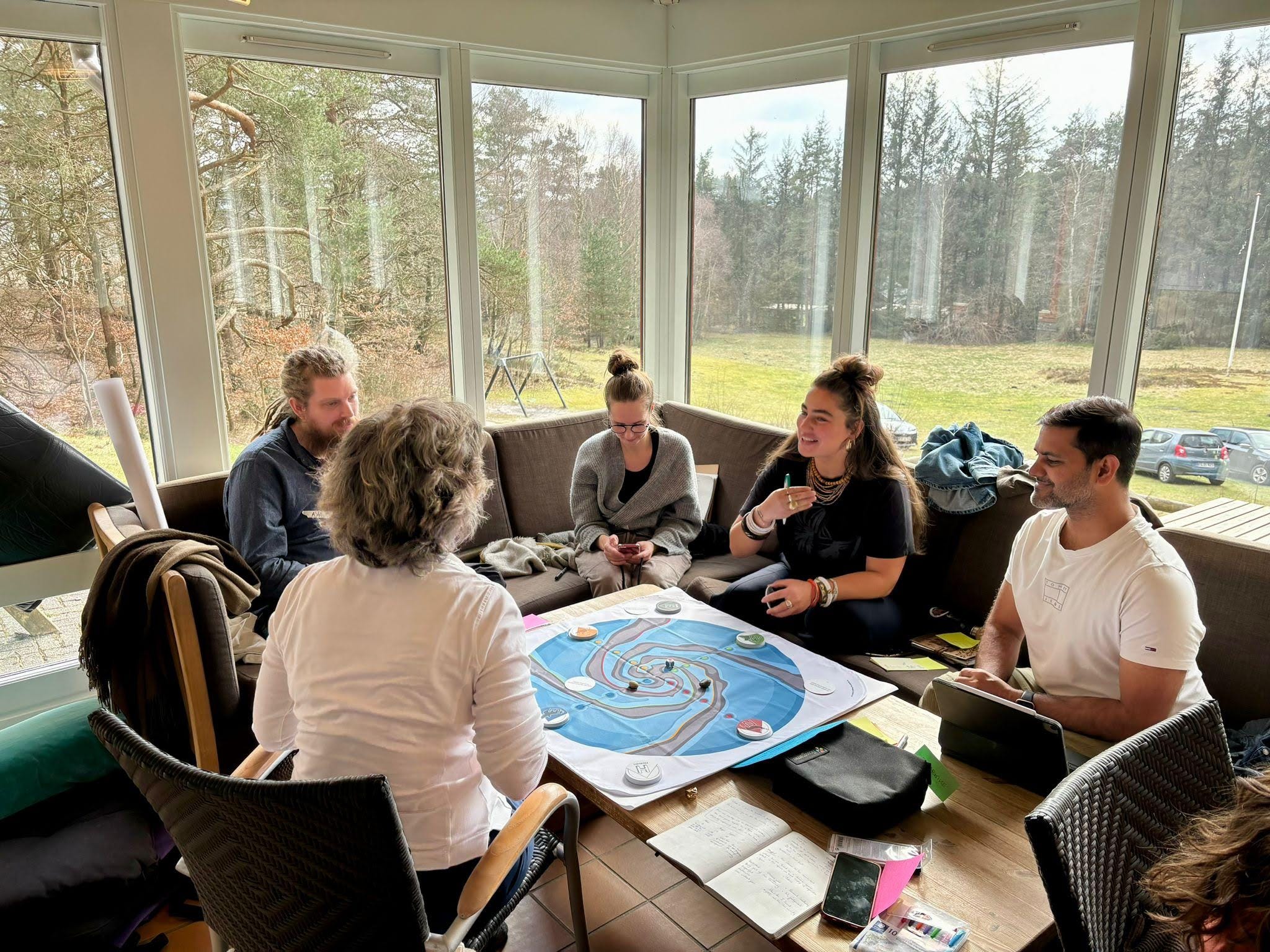
I have seen this principle come alive in various spaces such as the LEGO® SERIOUS PLAY® programs and Flow Game events for groups. In a Flow Game, when the group can touch a deeper intuitive space within themselves with the support of other group members who hold the intention to host themselves and each other in the space, magic happens. There is a certain universality of themes that we then discover and it opens up a wisdom that becomes accessible to the whole group.
In Bharata’s Nātya Śāstra, a classical Indian Poetics text, this process of individuals touching a space of oneness is termed as the attainment sahṛdayata. The process is called sādhāraṇīkaraṇam.
In the Process Work space, I have observed this principle come alive in moments when the facilitator stops trying to manage outcomes for the group and let emergence happen in the here and now. When the attention in the group remains relational and each voice takes its space, coherence appears as the emergence in the chaordic path. It also allows for the movement towards interdependence unfold in the group.
Svādhyāya, Pravacanam & Action Learning
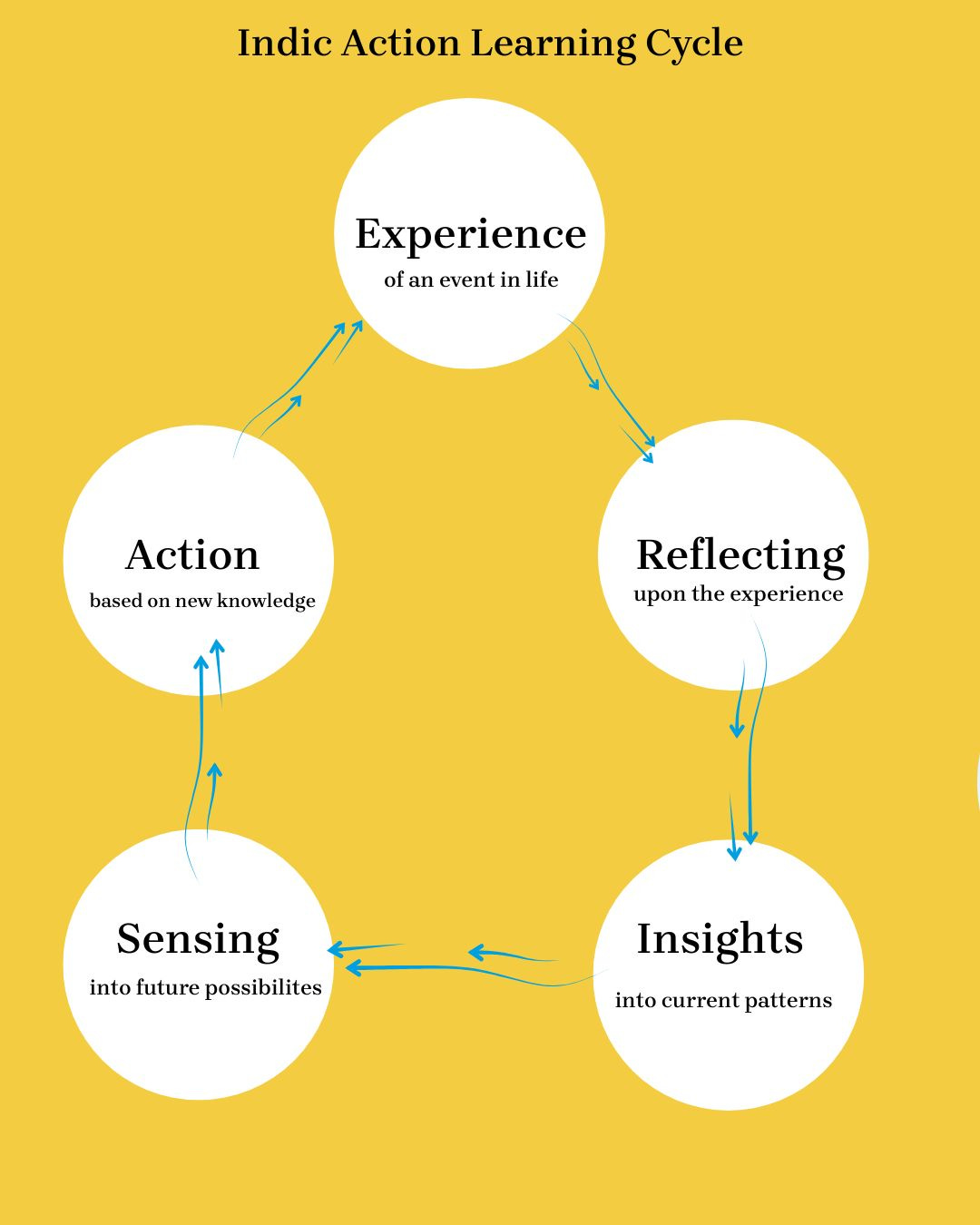
Indian Knowledge Systems emphasise a practice-based, embodied approach to learning. An ācāra is knowledge anchored in behaviour. During the convocation address of a student who has completed his education with his teacher, Śīkṣā vallī (Anuvāka 11) of Taittirīya Upanishad exhorts the student not break the continuity of life and learning through svādhyāya and pravacanam.
The Upanishadic learning process has three elements:
Śravaṇam: Deep listening to the teaching.
Mananam: Self-reflection to clarify the knowledge (jñānam)
Nidhidhyāsitavyam: Integrating and embodying the knowledge (vijñānam)
Pravacanam is the teaching, articulation, and transmission of the knowledge that one has integrated within oneself to the larger world. In the Indian tradition, learning remains incomplete without this element.
For me, Pravacanam is the space of action learning where one applies the insights gained in real-life situations in relation to one another. Action becomes the bridge between the inner integration arrived at through nidhidhyāsitavyam and the articulation of this in the outer world through pravacanam.
The Space of Magic
Magic happens in process work when one can practice returning to the here and now, again and again and again….with patience and compassion.
Staying with this process is the real work.
The Process is the work.
P.S.: I am excited and look forward to deepening my understanding of Process Work by being part of the ‘Theory and Practice of Process Work’ program offered by Sumedhas, co-facilitated by Sushanta Banerjee and Steve Correa in February 2026. If you are interested to learn more about the program or be part of it, feel free to reach out to me on phone or email.