

In April second week, I went home to celebrate Vishu, one of the two most important annual festivals of Kerala. Returning few days after an intense trauma work training in Somatic Experiencing and Family Constellation in Rishikesh made me to look at some of the key aspects of this festival from the lens of principles in trans-generational healing and nervous system regulation.
Origins of Vishu
Vishu word comes from the root word, vishuwat, i.e., samam (or equal). Traditionally, Kerala follow Solar calendar. Thus, Vishu marks the time when the Sun cross the equator, enter Meda rāśi, and starts its movement into the Northern Hemisphere. This is celebrated as a new year. The name given for the year 2025 is called Viśwāvasu. Interestingly, in Kerala we celebrate 3 new years! But that’s story for another day.
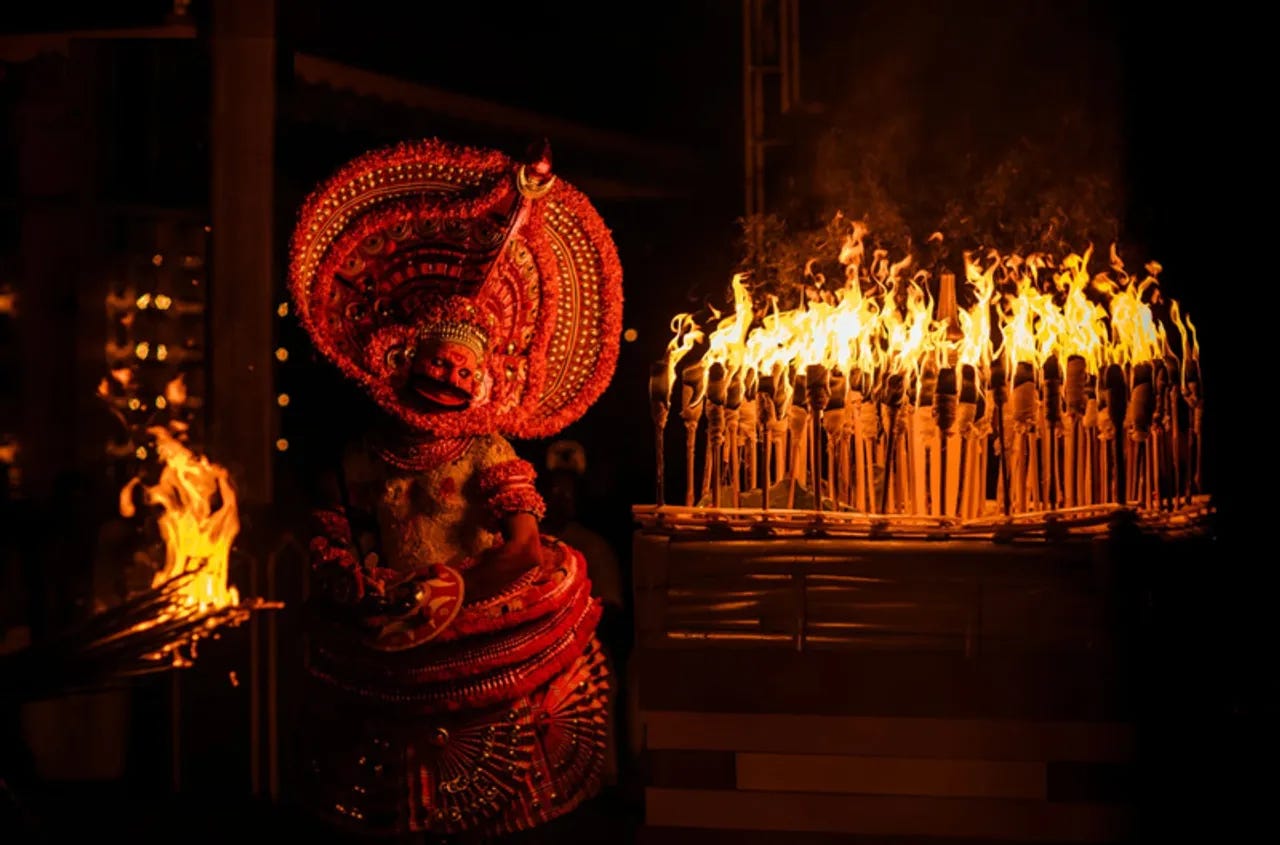
On the 10th day after Vishu, the Sun is directly over Kerala. This day is celebrated as Pathāmudayam (10th sun rise) in many Kerala temples, especially Devi temples. Traditional oil lamps are lit with 10 wicks to mark the ten sunrises after Vishu. This day also marks the start of the Theyyam (living gods) festival season in the Northern Malabar region of Kerala in the Kāvūs (sacred groves) after four months of silence.
The Vishu Celebration
Growing up I’ve fond and nostalgic memories of my grandmother, parents, and other elders in the house preparing Vishu Kaṇi late night on the eve of Vishu.
The curation of a Vishu Kaṇi includes Kindi (a type of pitcher) filled with water, njorinja vastram (fresh cloth), vālkaṇṇādi (a unique Kerala mirror with a handle), puthari (newly harvested rice), kaṇi konna (Cassia Fistula) flowers, swarṇam (gold), grantham (religious scripture, usually Devi Mahātmyam in Kerala), phalam (seasonal fruits such as mango, jackfruit, etc.), nava dhānyam (nine grains that represents the nine planets in the Hindu cosmology).
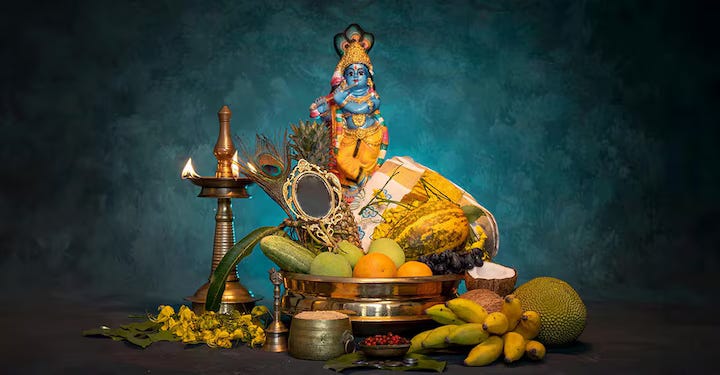
Kaṇi denotes the first thing you see upon waking up. On the morning of Vishu, my grandmother would wake me up, close my eyes with her palms and gently guide me towards the altar in the pūja room which is beautifully curated with an assortment of elements that invoke a feeling of abundance and beauty. As we open our eyes, we first have the darśanam (sight) of Kṛṣṇa vigraham (Krishna idol), then the auspicious objects around, and then take the mirror and look at ourselves through the mirror.
At this time, we sing a song that describes the journey of transcending our baser instincts to invoke the divinity within us. The elders in the family, then, offer a coin to the younger ones as Vishu Kaineettam.
Vishu Kaṇi ritual is a unique practice in the sense that it takes a departure from the usual practice of stepping into a pūja room or space of prayer after completing one’s morning rituals and ablutions.
Mythology, Symbols & Metaphors
Vishu celebration has a mythology, and certain key rituals and elements that create a rich tapestry of symbolism and metaphors for self-discovery.
Vishu Kaṇi
What are we really seeing when see a Vishu Kaṇi?
At Vishu Kaṇi, we first see Kṛṣṇa bhagavān. The Sanskrit word bhagavān has its root in bhaga which means “opulence” and vān means “one who possesses it”. Thus, bhagavān embodies the qualities of richness, abundance, courage, beauty and renunciation.
The idea is to start the new year with an experience of seeing this embodiment in front of us. The act of looking at the mirror after this is a reminder to ourselves that this potential is within us. Thus, we begin the new year with a intent and vision to awaken this potential within us as we engage with the world.
This is very much in alignment with one of the significant śānti mantras in the Vedic literature:
ॐ भद्रं कर्णेभिः शृणुयाम देवाः।
भद्रं पश्येमाक्षभिर्यजत्राःOm! May whatever I hear through my ears be auspicious.
May whatever I see through my eyes be auspicious.
As a daily practice, this is also an invitation for us to actively set an intention to be aware of our own meaning making processes and develop the capacity to welcome the events in life through the lens of the aishwaryam and act from that sense of auspiciousness and abundance within.
Mythology As Mirror
There are two stories from Indian mythology that is associated with the celebration of Vishu. One is from the Indian epic Rāmāyaṇa and the other from Bhāgavata Purāṇa.
Rāmāyaṇa
In Rāmāyaṇa, Rāvaṇa was ruling over Lanka and the world. He imprisoned some of the planets in Lanka including Rāhu and Ketu. When Hanumān burnt down Lanka, these planets were freed from captivity. This is also the reason for the widespread belief in praying to Hanumān to overcome the negative impacts of Rāhu and Ketu and bring positivity and harmony into one’s life.
In the case of Sūrya (Sun), Rāvaṇa did not imprison him. Instead, he warned Sūrya not to pass directly over Lanka. So, Sūrya could finally pass over Lanka only after the death of Rāvaṇa. Vishu is a celebration of this re-entry of Sūrya over Lanka.
Bhāgavata Purāṇa - Story of Narakāsura
A more popular story associated with Vishu is the story of the asura (demon) Hiranyākṣan.
Hiranyākṣan is the son of Diti and Sage Kashyapa. Through his austerities and penance towards Brahma, one of the Trinity Gods in Hindu pantheon, he gains the boon of invulnerability of being killed by neither God, man, nor beast. He goes on to capture Bhūmī Devi (Earth Goddess) and pulled her deep beneath the Cosmic Ocean. Other deities appeal to Viṣnu to save Bhūmi Devi and creation. Answering their plea, Viṣṇu takes the avatār of a varāha (wild boar), kills Hiraṇyākṣa, and rescues Bhūmi Devi.
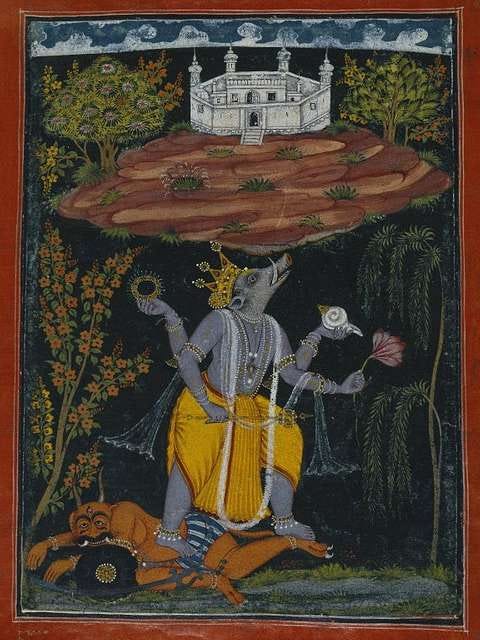
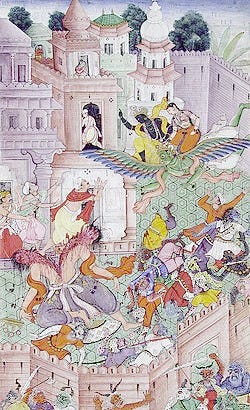
Hiraṇyākṣan kidnapped Bhūmi Devi. Narakāsura was his son through Bhūmi Devi. Narakāsura got a boon from Brahma after an intense penance that only with the support of his mother (Bhūmi Devi) he can be killed. After receiving this boon, he grew stronger and started wreaking havoc across the different worlds. Devendra, the King of the Devās (gods), approached Śrī Kṛṣṇa with the request to kill Narakāsura. Śrī Kṛṣṇa was with his consort Satyabhāma at that point. Satyabhāma was Bhumi Devi’s avatār. Śrī Kṛṣṇa leaves to kill Narakāsura with Satyabhāma by his side. First, they encounter and kill Murāsura who guards the borders of Prāgjyotiṣa, the capital city of Narakāsura. And finally, Narakāsura is killed with Sudarshana chakra by Śrī Kṛṣṇa. Vishu is a celebration of the death of Narakāsura at the hands of Śrī Kṛṣṇa.
Inner Transformation
So, what is the archetypal import of this story for our own self-discovery and growth?
It is important to understand that Naraka is not a hell that you visit upon death. Naraka is a space that is created in the here and now based on how we live our life.
त्रिविधं नरकस्येदं द्वारं नाशनमात्मनः ।
कामः क्रोधस्तथा लोभस्तस्मादेतत्त्रयं त्यजेत् ॥trividhaṃ narakasyedaṃ dvāraṃ nāśanamātmanaḥ
kāmaḥ krodhastathā lobhastasmādetattrayaṃ tyaje (B.G. 16:21)
Bhagavad Gīta (Chapter 16, Verse 21) speaks of three doors through which one enters naraka (hell), viz., lōbham (greed), krōdham (anger - wrath), and kāmam (desire - lust). These three are inter-connected. Once you develop a compulsive desire to get something, and when you do not get it, you experience great anger. Even when the desire is satisfied, it fuels the greed for more. The assumption that getting the object of desire will bring happiness is the root cause for this pattern to exist. Therefore, an intelligent person will take action to give up these three tendencies (lōbham, krōdham, kāmam).
In the story of Narakāsura, Bhūmi Devi represents one’s essence and fundamental truth. Hiraṇyākṣan is derived from the root words Hiraṇyam (gold) and Akṣam (eyes). Thus, Hiraṇyākṣan represents the quality of lōbham (greed) in our life. When our essence becomes enjoined by such greed, we become Narakāsura and create naraka (hell) for ourselves in our lives.
The boon Narakāsura received is that he can be killed only with the support of his own mother (Bhūmī Devi). That is, one needs to decide for oneself to kill the form of Narakāsura within through the integration of myself with the divine (Śrī Kṛṣṇa) in me. The five-headed Murāsura who protects the palace of Narakāsura represents the five organs of action and perception that aids creating the world of desires and greed. Mastery of the five senses is what will help one eliminate the hell created by the desire and greed-ridden mind. Sudarśanam implies cultivating the right vision (su - right or auspicious, darśanam - vision). Thus, Śrī Kṛṣṇa killing Narakāsura with Sudarśanam represents our capacity to overcome our own suffering created through greed by cultivating the right perspective while engaging with the world.
Thus, as one sees the Viṣu Kaṇi with the Śrī Kṛṣṇa, it serves as a reminder to nurture the right vision (sudarśanam) towards life. But is the right vision alone enough in life?
The Neuroscience of Vishu Through Somatic & Transgenerational Lens
The right vision without action will remain a fantasy or imagination. For real transformation, one needs to combine the right vision with the right action. So, what is the right action that is proposed in Indic thought? How does unreleased trauma in the nervous system impact this transformation? Let us explore.
Indian Knowledge Traditions propose that one’s actions need to align with the
repaying of the five debts with which each of us have taken birth in this world. These are:
Deva Ṛṇam - We are all graced by unseen energies that enable us to live life. Repaying this debt through the acknowledgement and remembrance of this grace with gratitude is called Deva Yajñam.
Pitṛ Ṛṇam - Acknowledging and revering the ancestors whose sacrifices and efforts helped shape me to be who I am. Even modern healing modalities such as Family Constellations speak of healing transgenerational trauma through restoring of fundamental principles of reverence, giving and receiving, and sense of belonging to one’s parents and their ancestral lineage. One practice that one can adopt is to visualise receiving the gift of strength from one’s father and gift of love from the mother.
Bhūta Ṛṇam - Knowing I am part of the inter-connected web of life along with all other beings (bhūta) while living in this world. Being compassionate and taking care of the fellow non-human beings around us such as fostering a cat, adopting a dog, feeding cows, choosing to use cruelty-free products, etc. can potentially become part of our practice of repaying this debt.
Manushya Ṛṇam - To support the well-being of fellow human beings. Practicing seva for fellow human being around you in whatever capacity that you are able to forms part of repaying this debt.
Ṛṣi Ṛṇam - Achāryās or teachers from whom we have learnt creates this debt. To share and teach what has been learnt from one’s teachers is the way to repay this debt.
When one is engaged in repaying these five debts as part of the daily living, it is unlikely for the mind to have the space to distract itself into unhealthy patterns.
Somatic Experiencing Principles in Vishu
The multi-sensorial nature of Vishu celebration is an excellent process of resourcing. Resourcing involves finding what supports us to feel present, grounded, and safe. This is a critical aspect in trauma resolution in Somatic Experiencing. The Vishu Kaṇi with all its varied rich and bountiful visual metaphors, Vishu song and firecrackers, elaborate feast, fragrance from the flowers, incense, and freshly prepared food, and the touch of new clothes, gifted coins, and ritual materials presents a powerful resource to anchor one’s attention for a new beginning.
This complete sensory engagement creates what psychologists call as “state-dependent memory”. State-dependent memory refers to the psychologial phenomenon where information learned in a specific physiological or psychological state is more easily recalled when the person returns to the same state.
Today we live a over stimulated and fragmented sensory world most of the time. The integrated multi-sensorial experience of Vishu offers a coherent sensory narrative that is increasingly rare. This synchronised engagement of all senses in a meaningful context creates what neuroscientists call “coherent neural oscillation” - a state where different brain regions synchronise their activity, promoting integration and well-being.
Transgenerational Healing Aspects of Vishu
Transgenerational healing occurs when individuals are able to become aware and break dysfunctional patterns carried across generations within a family system. The design of Vishu celebration enables this process through:
Power of Rituals - By collectively envisioning abundance at the start of a new year, families metaphorically interrupt patterns of anticipated lack through rituals that consciously focus on symbols of prosperity. Like with all rituals, the power of a ritual resides in the meanings held by the individuals who perform the ritual and the repetitive nature of rituals.
Temporal Bridge Across Generations - When children participate in the same rituals their grandparents and ancestors experienced, they enter a psychological continuum that extends beyond individual life spans. This sense of continuity provides an existential security and sense of being part of something larger and more enduring than oneself. This is a crucial need in today’s times when identities are becoming increasingly fragmented and isolated through individualisation.
Role Transmission - Younger ones in the family witnessing the elder ones in ceremonial roles which they will eventually inherit in the family allow for a graceful transmission of familial authority and a metaphorical apprenticeship. The roles taken up by the matriarch to arrange the Kaṇi, the elders giving Kaineettam to younger ones, etc. signify this role transmission across generations.
Intergenerational Comfort - For children, the multi-sensorial experience of abundance and prosperity becomes a formative experience. The combined sensory experience creates what psychologists call “safe attachment memories” - experiences of feeling secure and valued.
My deep gratitude to Brahmachāri Sudheer Chaitanya of Chinmaya Mission whose talk on the occasion of Vishu in 2024 is the inspiration behind this post.